Monday, January 10, 2011

Arizona Rampage Reignites Gun Control Debate in D.C.

By Shannon Bream

Rep. Gabrielle Giffords, D-Ariz., is a longtime gun owner and has often spoken out in support of broad Second Amendment rights. However, the tragic attack on Giffords that left six dead and 14 wounded is reigniting the debate over gun ownership in America.

In 2008 and 2009, Giffords signed on to briefs to the Supreme Court urging justices to overturn gun control laws that severely restricted the access of those who sought to purchase and own firearms. In both cases, the court ruled to roll back the restrictions. At the time, Giffords noted the “long tradition” of gun ownership in the United States adding, “It is a tradition which every law-abiding citizen should be able to enjoy."

Many of Giffords’ Democratic colleagues are taking a different tone, including Rep. Carolyn Maloney, D-N.Y., who said Sunday, "Guns kill. And those who glamorize gunplay or worship gun ownership do no service to humanity."

On Monday, Sen. Frank Lautenberg, D-N.J., announced that he is working with Rep. Carolyn McCarthy, D-N.Y., on legislation that would ban the manufacture and sale of high-capacity ammunition clips like the one allegedly used by Tucson shooting suspect Jared Loughner.

McCarthy, who lost her husband in a 1993 mass shooting, said the ban is something that was a part of the assault weapons law that expired in 2004. She said she’s been unable to get the prohibition re-enacted because “the House and the Senate are pro-gun houses.” Sen. Dianne Feinstein, D-Calif., the original author of the assault weapons ban, said Monday that she is also “looking at all the options” and hoping to work with colleagues on both sides of the aisle on the issue.

States have great latitude in passing their own gun laws, and Arizona is viewed as one of the most permissive. It’s a fact Pima County Sheriff Clarence Dupnik, also a Democrat, lamented on Saturday, saying, “I have never been a proponent of letting everybody in this state carry weapons under any circumstances that they want, and that's almost where we are.”

Loughner reportedly did pass a background check, as required in Arizona. There are now questions about his mental health, and whether a more thorough understanding of his possible condition might have affected his ability to purchase a weapon. At the same time, some lawmakers are pushing for action, others are urging caution.

Appearing on “FOX News Sunday,” Sen. Rand Paul, R-Ky., said the Tucson shooting is “probably about a very sick individual,” adding, “Weapons don’t kill people. It’s the individual that killed these people.”

Weapon in rampage was banned under Clinton-era law

The now-expired assault weapons ban made it illegal to make the type of magazine used in the Giffords shooting


The high-capacity magazine of the semiautomatic pistol used in the shooting of Rep. Gabrielle Giffords and more than a dozen other people on Saturday would have been illegal to manufacture and difficult to purchase under the Clinton-era assault weapons ban, which expired in 2004.

According to police and media reports, the alleged shooter, Jared Lee Loughner, legally purchased a semiautomatic Glock 19 with a high-capacity magazine in November at a gun store in Tucson. Under the assault weapons ban, it was illegal to manufacture or sell new high-capacity magazines, defined as those that hold more than 10 rounds. The magazines used by Loughner had 31 rounds each, according to police.

If Loughner had been using a traditional magazine, "it would have drastically reduced the number of shots he got off before he had to pause, unload and reload -- and he could have been stopped," Daniel Vice, senior attorney at the Brady Center to Prevent Gun Violence, tells Salon.

Between 1994 and 2004 when the assault weapons ban was in effect, gun manufacturers such as Glock could not market handguns with high-capacity magazines. If the ban were still in effect, it's less likely that Loughner could have obtained a gun with a high-capacity magazine. Stores could legally only sell used high-capacity magazines at that time, and new magazines could not be manufactured.

President Bush backed the ban, and an amendment to extend it passed in the Senate in 2004 but was never voted on by the House.

President Obama also supports renewal of the ban -- at least nominally. While he referenced the ban even in his Democratic nomination acceptance speech -- "don't tell me we can't uphold the Second Amendment while keeping AK-47s out of the hands of criminals" -- he has not pushed Congress to act on the measure.

The only significant legislation relating to guns signed by Obama is the credit card reform bill, which contains an amendment making it legal to carry concealed weapons in national parks. The Brady Center gave Obama an "F" for his first year in a report titled "Failed Leadership, Lost Lives."

State laws are also an issue. The Brady Center's Vice says that 10 states regulate assault weapons. In California, for example, Loughner could not have legally purchased a gun with a high-capacity magazine. Arizona, though, has among the weakest gun laws in the nation.

"Even if folks had seen Loughner with the gun walking up to the congresswoman, it was perfectly legal until he started firing," Vice says.

He also notes that Glock pistols are particularly easy to fire, letting off rounds as quickly as the operator can pull the trigger. "They are very good at killing people quickly," he says.

The company describes the Glock 19 model, "the all-round talent," this way:

The GLOCK 19 is ideal for versatile use through reduced dimensions compared with the standard pistol size. With the proven caliber of 9x19, it has found worldwide distribution in security services. In addition to being used as a conventional service weapon, it is suitable for concealed carry or as a backup weapon. For instance, many of the elite pilots of the USAF for instance trust the GLOCK 19 for their efficient defense in emergency situations.

Vice says the Brady Center will now push for a renewal of the assault weapons ban and more strict background checks.

"Our gun laws are so weak that someone who couldn't get into the military, who was kicked out of school, and who used drugs walked into a gun store and was able to immediately buy a semiautomatic weapon," he says.

Sunday, January 9, 2011

NH farmer is folk hero for gun rights advocates
By LYNNE TUOHY
The Associated Press
Saturday, January 8, 2011; 3:20 PM


http://www.washingtonpost.com/wp-dyn/content/article/2011/01/08/AR2011010802287_pf.html

 
MOULTONBOROUGH, N.H. -- Property and gun rights advocates have made a folk hero of Ward Bird, convicted and imprisoned for brandishing a handgun at a woman who trespassed on his remote hilltop land.

Their "Free Ward Bird" campaign has ignited support among townsfolk and strangers. Libertarian and tea party websites decry his fate: at least three years in prison. Protests and vigils are tweeted on Twitter and trumpeted on Facebook pages devoted to his case. Backers raise funds with $15 Italian buffet suppers and alt-bluegrass music and dancing.

Bird, married and the father of four children, hangs his hope for freedom on a pardon by Democratic Gov. John Lynch.

"I don't need people using me as a cause," Bird told The Associated Press. "I just want to be home with my family."

But a pardon is a rarity in New Hampshire. And Lynch, who hears Bird's case Jan. 19 with a five-member Executive Council, believes pardons are warranted "only under extraordinary circumstances or a gross miscarriage of justice." The governor doesn't vote on pardons - he can only veto the council's vote to grant one.

Court records, testimony and interviews show conflicting accounts of how Bird, 49, wound up in the Carroll County Jail, reading seed catalogs and pining for fresh air and sunshine.

Christine Harris ignored numerous "No Trespassing" and "Keep Out" signs when she drove up the remote road to Bird's home the afternoon of March 27, 2006. She says she was lost, trying to find a property for sale.

Bird, who did not testify at trial, says he repeatedly asked her to leave. Harris says he ran at her from his porch, screaming profanities. She got back into her truck; he turned to go back into his home.

There was his handgun, his Sig Sauer .45-caliber pistol. She says he brandished it at her as he charged at her. He says it was tucked into his back waistband, revealed only to Harris when he removed the ammunition as he went inside.

After two trials, Bird, a farmer, was convicted of criminal threatening with a handgun - a charge that carries a mandatory minimum three-year sentence in this "Live Free or Die" state. The state Supreme Court upheld his conviction, and he was locked up Nov. 17.

Bird's case has generated outrage among lawmakers. Republican House Speaker William O'Brien last month took Lynch a petition signed by 117 state representatives. O'Brien said Bird's incarceration is a miscarriage of justice.

"Any one of us has the right to tell a stranger to leave," O'Brien said.
He said that includes showing a gun to emphasize the request. He said the law used to lock up Bird needs to be revisited.

Indeed, new legislation inspired by Bird's case would allow the display of a gun by a homeowner who feels threatened, without risking prosecution.

Harris, of Salem, N.H., testified that she saw - and disregarded - numerous "No Trespassing" and "Keep Out" signs as she drove along the road to Bird's hilltop home. She had phoned the Bird family the night before, asking if they or their relatives had property for sale. They told her they were not interested.

Harris said Bird came at her from his porch "waving his arms like a maniac" and repeatedly ordering her to get off his property during the 10-minute encounter.
"He ran - jumped off the porch and ran a few steps towards my car as I was backing out," she testified. "All I know is Mr. Bird was waiving the gun at me on the porch, running back and forth."

She said he was about 30 feet away from her "screaming at me obscenities."

Bird told the AP in a recent interview that he did not wave or point his gun at Harris.

"I asked her to leave, repeatedly," Bird said. "She refused to do so and kept asking questions I wasn't interested in answering. I ended up raising my voice and using some profanity."

Bird said that when Harris got in her truck, he turned to re-enter his house and took his handgun from his back waistband. He said he removed the weapon's ammunition before entering his house.

Bird was indicted on a reckless-conduct charge. Prosecutors added the criminal threatening charge nine months before his first trial, which ended in a mistrial.
Prosecutor Susan Boone said that between trials Bird was offered a plea deal for reckless conduct, which carried no jail time but probation - and loss of his right to possess a gun - for two years. Bird said he rejected it because he did nothing wrong. He was convicted by a jury on June 30, 2008.

Carroll County is awash with signs on snow banks and business marquees proclaiming "Free Ward Bird." Protests, vigils and caravans of cars crisscrossing the state have touted his cause.

"There has been a huge community outpouring," said local contractor Jon Tolman, a friend of the Birds. "Lots of people are contributing to trying to make this right.
Cato Institute Chairman and attorney Robert Levy, who successfully challenged the District of Columbia's handgun ban in a landmark 2008 U.S. Supreme Court ruling, said Bird's case doesn't rise to a 2nd Amendment challenge. States can regulate what people can do with a handgun on their property, he said.

"That doesn't change the fact that it's an outrage," Levy said. "You have pardons to correct for outrageous. It would seem this would qualify."

Bird now wishes he had testified but agreed at the time with his lawyer, Mark Sisti, that it didn't seem necessary.

"The case was overwhelming at that point, we thought," Sisti said. "I was surprised the charge was brought, and I was shocked at the conviction."

Sisti said he knows of no precedent for arresting a property owner when someone is trespassing and resisting requests to leave.

Superior Court Judge Steven Houran said he regretted having to sentence Bird to the mandatory minimum. He urged the transfer of Bird to the county facility so that he might be eligible for work release after 90 days.

Bird's wife, Ginny Bird, said she is trying to keep life "normal" for their four children, ages 10 to 18. They visit Bird for one hour each week.

"It's amazing how much support we have in the community, and they feel that," she said.

A state deeply in love with its guns

Gerard Wright LOS ANGELES
January 10, 2011
http://www.smh.com.au/world/a-state-deeply-in-love-with-its-guns-20110109-19jy8.html

BEAUTIFUL, vast, rugged and unforgiving, Arizona's postcard landscape is matched by the frontier mentality of many of its populace: not so much lawless, but deeply conservative, and wedded to the idea that happiness truly is a warm gun.

Its border with Mexico is porous, regularly and easily traversed. Phoenix, its largest city, has become a waypoint for drug and human trafficking.

The state has also been hit hard by the recession, which has helped make it a centre for anti-immigrant rhetoric and tough-talking Republicans like Sarah Palin, whose "Tea Party" web page included an image of gunsight crosshairs on targeted congressional seats, Gabrielle Giffords's among them, and the slogan, "Don't Retreat, Reload".

As the local Pima County sheriff, Clarence Dupnik, suggested, the gunman's actions did not spring from a vacuum.

Under laws passed last year, any state resident over 21 can carry a concealed weapon without a permit. The state has also been hit hard by the recession, which has helped make it a centre for anti-immigrant rhetoric and tough-talking Republicans like Sarah Palin, whose "Tea Party" web page included an image of gunsight crosshairs on targeted congressional seats, Gabrielle Giffords's among them, and the slogan, "Don't Retreat, Reload".

Previously, the state had an "open carry" law, allowing licensed gun owners to publicly carry their weapons. This led to a scene outside a convention centre in Phoenix in August 2009, where a dozen firearm-carrying protesters gathered, including one with a semi-automatic rifle slung over his shoulder, as Barack Obama spoke inside.

The hostility to the President is more than symbolic. That same month, Steven Anderson, a Baptist pastor in suburban Tempe, was revealed to be leading his congregation in prayers for Mr Obama's death.

Ms Giffords's election opponent last year was the ultra-conservative Tea Party-endorsed Jesse Kelly. His campaign included an invitation to shoot an M16 assault rifle with him.

"This is a gun-happy state," said David Fitzsimmons, a Tucson cartoonist. "In this state, it has become a fetish.''

Saturday, January 8, 2011

January 7, 2011 5:20 PM PST

HTC phone battery stops bullet, saves life

http://news.cnet.com/8301-17852_3-20027876-71.html

Earlier this week, an Illinois man managed to leave his cell phone in his back pocket, a choice that ended up, thanks to his rolling bottom, with his wife calling the police, who sent a SWAT team to the man's place of work.

John Garber, a valet from an Atlanta nightclub might now be dead if he'd kept his cell phone in the same place.

According to the Associated Press, Garber was working at Club Halo when two men were thrown out of the club. Police say that the men allegedly ventured over to a car, grabbed some weapons and began to shoot indiscriminately in the direction of the club.

One of the bullets went through Garber's coat and was about to do him severe damage. Suddenly, it was intercepted by his HTC phone, which he had put into the chest pocket of his jacket.

Garber's coat is now adorned with a bullet hole. The top left corner of his red cell phone battery now enjoys a dent that signifies it wouldn't let the bullet through.

No one was injured in this shooting and police happened to be near the club and managed to chase down the alleged shooters, from whose car they reportedly recovered two handguns.

Garber told the AP: "It's just one of those crazy things in life."
And did he reportedly make one of those post-traumatic statements about never buying another brand of phone again?

Why, yes. Strange that you should ask, he reportedly did.
I wonder whether the Illinois man who caused the butt-dial now keeps his cell phone permanently on guard over his chest every night before going home.

Friday, January 7, 2011

Reviewed by David M. Kinchen
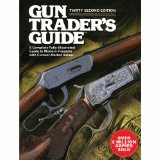
BOOK REVIEW: 'Gun Trader's Guide':  The Best Reference Book for Gun Collectors Continues Stoeger Tradition in New Skyhorse Edition
When Stoeger Publishing Co. was discontinued a few years ago by Stoeger Arms's new Italian owners, Skyhorse Publishing of New York City decided to step in and continue the tradition with "Shooter's Bible" and "Gun Trader's Guide."


Gun owners and collectors should support Skyhorse and buy their books to reward them for continuing a glorious tradition.

I recently reviewed the 102nd edition of "Shooter's Bible" (Link: http://www.chronwatch-america.com/articles/8002/1/Book-Review--quotShooters-Biblequot/Page1.html) ; and I'm happy to report that the 32nd edition of "Gun Trader's Guide" (Skyhorse, 606 pages, color and black and white photos,  $29.95) is as good or better as it was when Stoeger published it. I found all my guns in it and I'd be hard-pressed to fault it in any way. Together, "Shooter's Bible" and "Gun Trader's Guide" belong on your bookshelf or next to your gun case.


This  is the original reference guide for gun values. For more than half a century, this book -- of which more than 2 million copies have been sold -- has been the standard reference for collectors, curators, dealers, shooters, and gun enthusiasts. It is the definitive source for making informed decisions on firearms purchases. Included are extensive listings for handguns, shotguns, and rifles from some of the most popular brands, such as Remington, Colt, Browning, Winchester, Beretta, Smith and Wesson, Ruger, Glock, and many more foreign and domestic brands, including brands of the past like Harrington & Richardson, Iver Johnson and High Standard (H&R and High Standard have been resurrected following their ceasing operations in the 1980s).


I found my Plainfield Machine Co.  M-1 carbine in the book, as well as several guns I no longer own (but wish I did!).  Judging by what  the M-1 cost me, I paid a bit too much, but it's such a sweet shooting rifle I don't care. There's no comparison with "Gun Trader's Guide" and the annual gun guides you see on magazine racks in stores.


To make it easy to use, this fully updated edition are a complete index and a guide on how to properly and effectively use this book in order to find the perfect firearm type and model. No matter what kind of firearm you choose to shoot, whether you are a hunter or a collector, whether you have a lifetime of experience with firearms or are just being introduced to collecting, this is THE BOOK.
 
http://www.huntingtonnews.net/512

Publisher's website: www.skyhorsepublishing.com

Firearm of historic significance donated to Witte

Gun is among artifacts from Indianola.
Published: 12:00 a.m., Friday, January 7, 2011

Read more: http://www.mysanantonio.com/default/article/Firearm-of-historic-significance-donated-to-Witte-941323.php#ixzz1AON3X3Q9

The old single-barrel, smoothbore firearm has a little pitting on the steel, and the stock has a few dings.

But what separates it from grandpa's keepsake is the engraving on the part-octagon barrel — “F. Klamberg Indianola Texas” — proving it is from one of the state's settlers and an extremely rare firearm.

Only two exist that are known to have come from Indianola, Texas' second-busiest port in the mid-1800s until it was hit by a hurricane in 1875 and wiped out by another in 1886, leaving few artifacts behind.
The firearm, which could be used as a shotgun or to fire a round ball, is part of the Indianola collection donated to the Witte Museum by Donald and Louise Yena. The collection also includes:

A stamp from Woodward Brothers Merchants

A locket with a woman's photograph and the inscription C.W. Short

A photograph of Freidrich Klamberg, the firearm's owner, dated Aug. 21, 1868

Documents illustrating everyday transactions, including a ledger from merchant B.W. Varnell; a receipt for Isaac Brower dated Dec. 12, 1865; a brand certificate for William King dated July 9, 1875; and a memo from Tres Palacios Packing House dated June 6, 1876.

And, although not from Indianola, a leather gun bag and powder horn from the period to go with the gun.

No museums have firearms from Indianola, said Bruce Shackelford, Brown Foundation curator at the Witte.

“There are other firearms that can be documented to Texas settlers, but not many,” Shackelford said.

Before the Yena donation, the only Indianola artifacts at the Witte were a few documents.

“We're just thrilled to get anything like this,” Shackelford said. “Anything we can get from Indianola is important because it was the landing place for so many European immigrants.”

Donald Yena, a renowned Western artist and collector of 1800s Texas artifacts, described the gun as “the centerpiece in our collection for 22 years.”

“When you find a gun from a Texas settler with his name on it, that's the holy grail,” he said.
The firearm, a smooth-bore 20-gauge muzzle loader, probably was brought by Klamberg from Germany in the early 1850s, Yena said. A gunsmith and jeweler, Klamberg was headed to New Braunfels but stayed in the bustling port of Indianola, where he set up shop before moving to Victoria.

It is the best of the two Klamberg firearms known to exist, Yena said.

Originally a flintlock, the gun was converted to the era's cutting-edge technology, a percussion firing system.
The walnut stock shows fine hand checkering on the pistol grip and forearm, which is slightly worn from use. The original wooden ramrod tucks neatly below the barrel.

“You can tell this was a prized possession by the way Klamberg took care of it,” Yena said. “There is quite a bit of bluing left. The gun is in remarkable condition for a firearm of its type.”

The Yenas have a long relationship with the Witte.

In 1994, the museum purchased the Donald M. and Louise Yena Collection of more than 2,000 Texas artifacts ranging from firearms, saddles and gambling paraphernalia to kitchenware.

Items from the Yena collection are displayed in exhibits such as the current “1910: A Revolution Across Borders,” marking the centennial of the Mexican Revolution.

“Don Yena: Painting the South Texas History,” an exhibit of a dozen 36-by-60-inch oil paintings depicting turning points of the cattle industry, was displayed in the fall of 2009 and extended through the summer of 2010 by popular demand.

“Don and Louise Yena are part of the Witte's extended family of people passionate about the historic stories of South Texas,” said Witte President and CEO Marise McDermott.

The focus of the Yenas' collecting parallels the Witte's efforts to illustrate the history of South Texas, from Spanish colonial vaqueros to the ranching, farming and mercantile industries through the 1800s, McDermott said.
“We're very grateful of their lending and generosity — and their research. They've really helped us,” she said. “The Indianola story is the story of a town that disappeared.

“To have the ensemble of artifacts that the Yenas contributed helps reveal a hidden history.”

While there are no plans to display the Indianola artifacts, they may play into the opening exhibits of the Witte's South Texas Heritage Center, incorporating Pioneer Hall with an expansion to some 20,000 square feet, in the spring of 2012.

John Goodspeed is a freelance writer and photographer. E-mail him at john@johngoodspeed.com